
To impress and influence audiences, you need to connect! Dramatically improve your eye contact with this simple technique.
You know that strong eye contact is needed for successful public speaking, right? And no wonder!
Establishing an eye-to-eye connection not only builds trust. It's also a key skill of effective body language, which in turn is part of nonverbal communication. That means all the aspects of your speech apart from the words. Often, that can be the most persuasive part of your presentation.
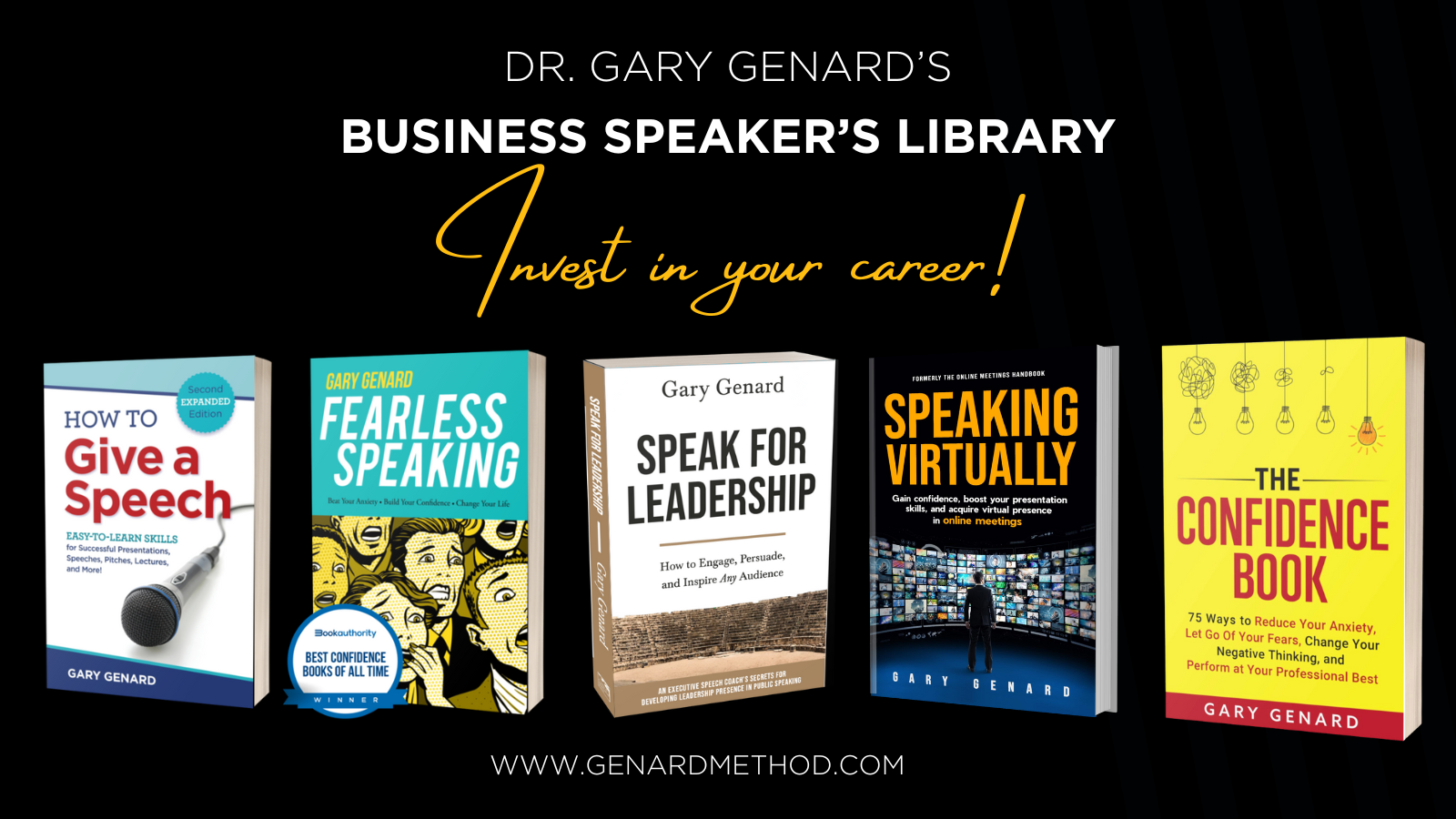
Ready to rock when it comes to speaking for business? Learn the skills you need! Visit my Business Speaker's Library. It's also on Amazon. Or click on the image below:
Sometimes, however, looking audience members in the eye isn't easy. That's especially true when you're nervous and self-conscious about your speaking. It's hard to stay focused and present when thoughts about your own lack of skills hijack your thinking.
Wouldn't you rather be in The Zone when you speak, relaxed yet completely focused? Find out how! Download my free cheat sheet, "How To Calm Your Nerves before Speaking."
I recently coached a client who had considerable trouble looking listeners in the eye. In fact, it was the first issue he brought up in our initial conversation. And sure enough, I saw it in action immediately when we started working together.
For instance, even though we were sitting in armchairs no more than 4 feet apart, he avoided looking at me probably 80% of the time. As you can imagine, this reduced both his friendliness and his credibility. Wouldn't you ask yourself this question if someone is avoiding eye contact: "Why won't this person look me in the eye?"
Speaking of nonverbal communication, how is your body language? Get my Free White Paper, "The Body Language Rules: 12 Ways to Be a More Powerful Speaker."
How Important is Trust in Public Speaking?
My client knew this was a problem both in presentations and interpersonal communication, but he had no idea how to overcome his shyness. And that, in fact, turned out to be an important clue for me.
He had mentioned that he was an introvert. And that character trait can be related to weak eye contact. Introverts not only frequently want to build a beautiful structure when speaking in public. They'd also rather not deal with the uncertainties that presenting in front of a group of strangers can bring. Of course, in the rough-and-tumble of public speaking and Q & A, we seldom have the luxury of creating an ideal presentation and presenting it in perfect conditions.
Do you lack confidence like this when you speak? Speak with the sound of leadership! Get my Free Tips and Tricks Guide, "The Voice of Authority: How to Sound Like a Leader."
I gave him two reasons why strong eye contact is critical to speaking success, regardless of whether a speaker is introverted, extroverted, or somewhere in between. Here they are:
- People seldom trust speakers who don't look them in the eye. From children with crumbs on their lap who deny raiding the cookie jar, to car salesmen, to lovers swearing their devotion, eye contact is visual reinforcement of someone telling the truth.
- Audiences are easier to get a response from than speaking into the void. Speakers sometime defend their lack of eye contact by saying, “But if I look the audience in the eye, I’ll forget what I’m saying!” At this point I usually respond: “Which do you think is going to give you something back, the rear wall or the people you’re talking to?”
Listeners give you energy—not suck it out of you. Speaking to an audience that cares about the topic at hand should be a delightful activity. That includes watching their responses, and responding to them in turn. People not only expect you to look at them when you talk. They’ll trust you more if you do; and perhaps won't trust you at all if you don't.
Learn more about creating influence with business audiences. Download my Free eGuide, "4 Characteristics of An Influential Speaker."
An Exercise to Improve Your Eye Contact
Here's an exercise I used with the client I mentioned above to strengthen his weak eye contact. It was also helpful in weaning him away from his tendency to be more comfortable with his content than with the people he was talking to:
I prepared 20 impromptu speech topics, which I folded and placed in an 8 x 10 envelope. My client had to reach in, choose a topic, then look up at me and speak about it for 2-3 minutes. Understand, please, that I gave him no time to prepare. No nicely wrapped speech package possible here! We did this four times in succession without a break.
I'd intentionally chosen topics that he didn't have any expertise in; and in fact, none had a right or wrong answer. They were general topics and were more concerned with his opinion than his knowledge. They were along the lines of, "What is America's greatest challenge in the 21st century?" or "Tell me about a person who positively changed your life."
The result? For 90% of the time, he looked directly at me with rock-solid eye contact!
The reason, you see, is that he couldn’t “go away” somewhere mentally and marshal relevant data on the subject. His professional experience gave him no special knowledge on these topics. Instead, he had to speak while accessing his own thoughts and experiences, since he couldn't find the information he needed anywhere else in the room.
Since there was nowhere else for him to turn, he had to look his listener in the eye, even if he wasn’t sure what he was about to say. His job now became to reach his audience through what he was saying, not fashion the perfect answer.
That's your job, too, don't you know?
You should follow me on Twitter here.
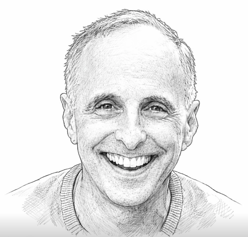
Gary Genard is an actor, author, and expert in public speaking and overcoming speaking fear. His company, The Genard Method offers live 1:1 Zoom executive coaching and corporate group training worldwide. He is the author of the Amazon Best-Seller How to Give a Speech. His second book, Fearless Speaking, was named in 2019 as “One of the 100 Best Confidence Books of All Time.” For nine consecutive years, he was ranked by Global Gurus as one of The World’s Top 30 Communication Professionals, and he has been named as one of America's Top 5 Speech Coaches. His handbook for presenting in videoconferences, Speaking Virtually offers techniques for developing virtual presence. He is also the author of Speak for Leadership: An Executive Speech Coach's Secrets for Developing Leadership Presence. His latest book is The Confidence Book: 75 Ways to Reduce Your Anxiety, Let Go of Your Fears, Change Your Negative Thinking, and Perform At Your Professional Best. He is also the creator of The Dr. William Scarlet psychic mysteries. Contact Gary here.
Photo credit: Road Trip with Raj on unsplash.com.