
Fear of public speaking isn't just a mind game you seem to be playing. And that fact can be helpful. Here's how your body reacts and what to do about it.
Public speaking is a performance art, whether it's an actor performing Shakespeare or you presenting to your internal team or pitching to a client. And just as is true of actors, what you bring to the stage will help make the difference between mediocrity and excellence.
If, however, you're one of the many people who experience fear of public speaking, this type of influence can seem beyond reach. But take heart, as there exist easy and effective ways to reduce your speech anxiety. This article covers three of them.
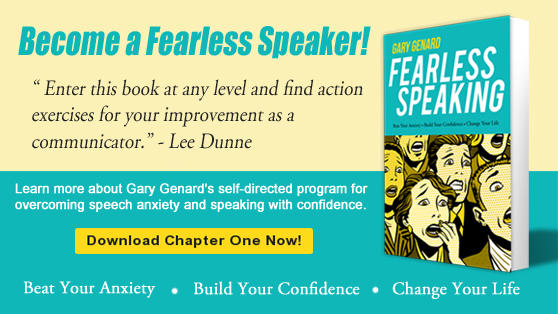
Is fear of speaking holding you back? Get Fearless Speaking, named "One Of The 100 Best Confidence Books Of All Time." On Amazon. Click on image below for free chapter!

Consider further the connection between the theater and business: Actors speak from a script, just as you use content in your presentations. In either case, the sheer information delivered can't achieve the type of influence desired.
For instance, a bare script will never convince an audience they're watching a real human being with real passions . . . and neither will your PowerPoint or handouts. The key ingredient in both situations is the speaker in performance. Along with strong intentions, that means the uses and responses of the body.
To remain in The Zone so you can present at this level, download my free cheat sheet, "10 Ways to Stay Fully Focused when Speaking."
How Your Body Responds to Speech Anxiety
A normal reaction to make-or-break presentations is speech anxiety or glossophobia. Millions experience it, from pre-speech nerves or "butterflies," to extreme self-consciousness, to full-blown panic. Fear of public speaking can manifest itself in many ways—but a reliable symptom of stage fright is the physical response the speaker experiences.
Your body's reaction to any fearful situation can be powerful. It's one reason speech anxiety is such an uncomfortable and seemingly intractable problem. Another factor is the inappropriateness of the body's response. Public speaking isn't a truly dangerous situation, though if you have speech phobia you may experience it that way.
What about situations that actually come closer to being risky? Download my Free How-To Guide, "How Survive the 7 Danger Zones of Q& A." Learn these valuable coping tactics!
Three physical responses predominate when speech phobia rears its head: (1) Galloping heart rate (sometimes with a pounding sensation); (2) Rapid and shallow breathing; and (3) The release of stress hormones, in particular epinephrine ("adrenaline") and cortisol. A wide array of other symptoms may include sweating, a shaky voice, nausea, trembling hands, light-headedness, etc. But the responses above are the reliable "Big Three."
Dealing with Your Physical Symptoms
Fortunately, there are some simple and effective techniques for dealing with the physical symptoms of speaking fear, whether you experience them singly or (more likely) a number of them at the same time. The following three approaches in particular can bring reliable relief:
1. Progressive Relaxation. Lie on your back with arms and legs uncrossed. Imagine a warm feeling in your scalp releasing all tension there. Keep that feeling on the top of your head, as you slowly allow that sensation to "flow" downward, relaxing each part of your body in turn. Now bring this feeling of total relaxation into your muscle memory. You can then call on it when you're getting nervous and tightening up prior to a speech.
2. Diaphragmatic Breathing. Breathing with the diaphragm or "belly breathing" is natural respiration. That's because the diaphragm needs to flatten so your lungs have maximum room to expand. Slow, deep diaphragmatic breathing like this oxygenates you fully, helping calm the heart and alleviating the rapid shallow breathing of anxiety. Here's how to calm your nerves before speaking. And here's another great way that breathing can help control your fear of public speaking.
3. Movement. Adrenaline is part of a "fight or flight" response, which has nowhere to go: you can't fight your audience and you can't run out of the room! Simply moving will help dissipate this nervous activation. While waiting to speak, for example, tighten and release your muscles. And while you're speaking, make gestures and the use of space part of your performance.
Your physical reactions to public speaking fear are a reminder that speech anxiety isn't all "in your head." That's good news, since techniques to counter the body's responses can be more easily enacted, with a quicker payoff, than the more time-consuming task of restructuring your thinking. When you have that time and you're ready, though, here's how to utilize a comprehensive, holistic approach to becoming a more comfortable and confident speaker.
You should follow me on Twitter/x.com here.

Gary Genard is an actor, author, and expert in public speaking and overcoming speaking fear. His company, The Genard Method offers live 1:1 Zoom executive coaching and corporate group training worldwide. For nine consecutive years, he was ranked by Global Gurus as one of The World’s Top 30 Communication Professionals. He is the author of the Amazon Best-Seller How to Give a Speech. His second book, Fearless Speaking, was named in 2019 as "One of the 100 Best Confidence Books of All Time," and he has been named as one of America's Top 5 Speech Coaches. His handbook for presenting in videoconferences, Speaking Virtually offers techniques for developing virtual presence. He is also the author of Speak for Leadership: An Executive Speech Coach's Secrets for Developing Leadership Presence. His latest book is The Confidence Book: 75 Ways to Reduce Your Anxiety, Let Go of Your Fears, Change Your Negative Thinking, and Perform At Your Professional Best. He is also the creator of The Dr. William Scarlet psychic mysteries. Contact Gary here.
Photo credit: Kanenori on pixabay.com