Do you get right to the point to speak with impact? If you're too wordy, here are seven ways to speak concisely.
Let's talk about conciseness. Especially in speaking virtually, when you are so much of everyone's focus.
And if you don't use full sentences to do so? No matter.
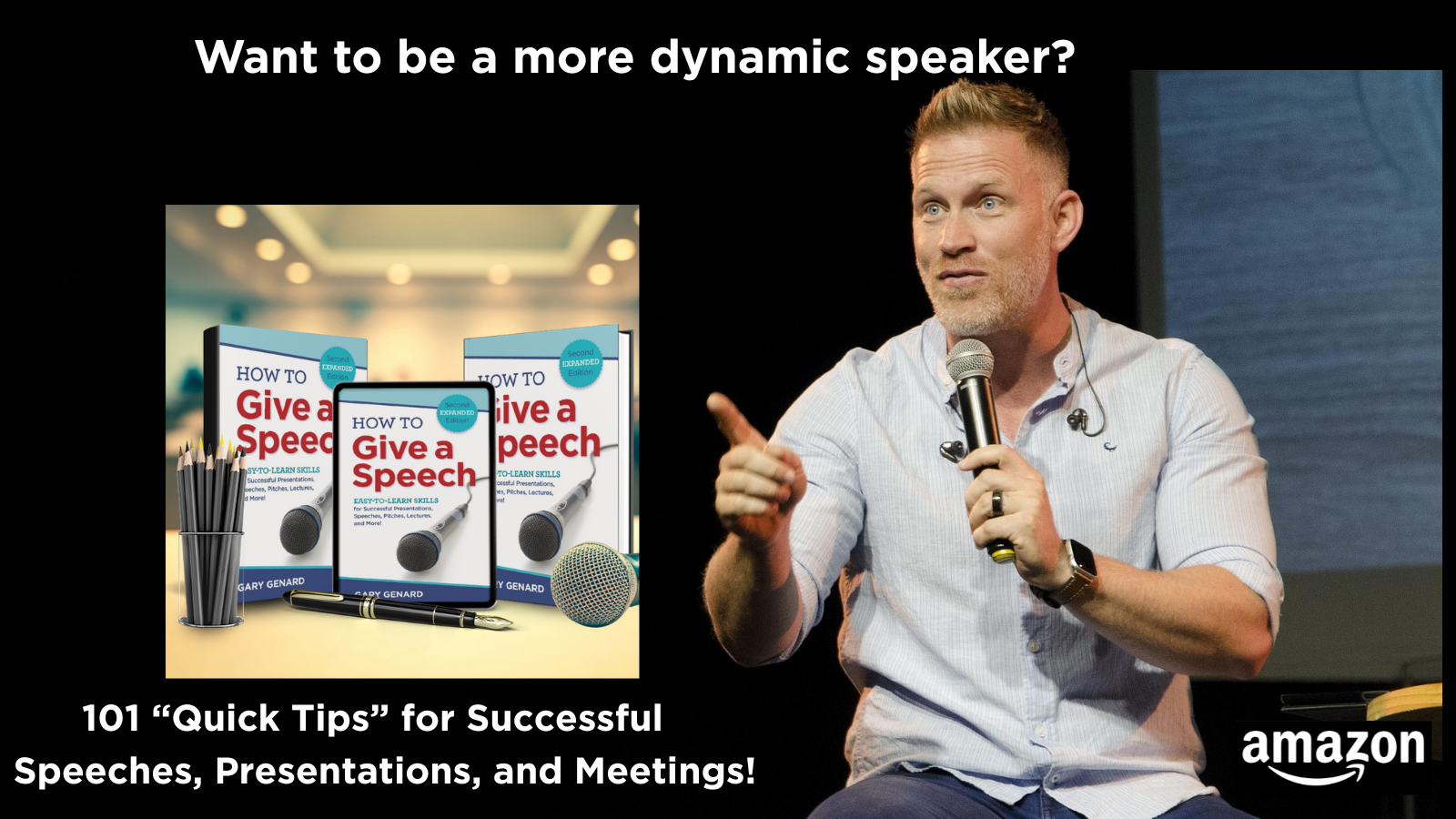
Conciseness usually equals successful communication! Read Chapter 5, "Delivering Your Messages Successfully," in my book, How to Give a Speech. Also on Amazon.
Why is conciseness so important?
Well, for one thing, we write in sentences, but we speak in emotions and ideas. So, relying on a manuscript can make you sound too wordy. How can you correct that? Simple. Grab the phrase or idea from the script and look up at your listeners to say it. Then look down and get the next one. Listeners won't mind the second or so it takes you to do this.
Below are more ways to avoid wordiness and be an economical (and appreciated) speaker.
Ready for the big leagues? Learn how to speak with real impact. Raise the bar on your performance! Get my Free eBook, High-Impact Speaking: The Leader's Guide.
7 Ways to Speak with Impact
im.pact n. 3. The effect or impression of one thing upon another. (The American Heritage Dictionary, 2d College Edition.)
That's you, making an impression on your audience. In this case, by being concise. Another way to say that is being focused in terms of language.
Want more on developing focus as a speaker? Download my essential cheat sheet, "10 Ways to Stay Fully Focused When Speaking."
Given today's frequent virtual meetings, you need to be concise for the following reason: unless you're showing visuals, people have only your face to look at. Since nothing else is happening visually, if your message isn't tight they'll be tempted to look elsewhere (such as at their cell phone). You need them to stay tuned and NOT thinking you're wasting their time.
Here are seven "Do's" to help make that happen:
1. Avoid "throat-clearing." This is pure habit; and with a little practice, it should be easy for you to stop. "To get started today," "Before I begin the presentation" (hint: you've already begun!), and, "As I said before," are examples of this "Ahem, ahem!" style of speaking.
Do you want to move audiences? You need a powerful opening! Learn how it's done. Get my Free resource, "How to Start a Speech: 12 Foolproof Ways to Grab Your Audience."
2. Stay away from diminishing language. This is a very common speech error. But unlike using too many "ah's" and "um's," we're usually not aware that we indulge in it. Examples include “I want to talk a little bit about . . .” and "Just," as in, "I'd just like to go over. . ." Every main point in a presentation is there for a reason, and is therefore important. Make sure it sounds that way!
3. Build a corral. This one's great if you tend to ramble on your way to the winner's circle. A corral holds horses, right? Similarly, your word-corral keeps you firmly within bounds. "Today, I'm going to discuss three aspects of this topic," is a speech with a corral in place. So is this answer: "There are two things I'd like to say in response."
4. Shut up. Don’t over-explain.
5. Be disciplined. The road to hell is paved with good intentions . . . along with speakers who go down "interesting paths." If you've thought carefully about your purpose in speaking, you will only include content that helps you achieve that goal. Stay on the beam. And keep a firm grip on time management.
Here's more on first-class speaking to engage and move audiences. It's my Free Presenter's Guide, "Six Rules of Effective Public Speaking." Download it now!
6. Pause. It's hard to say too much when you're not saying anything. Pauses are valuable for all kinds of reasons. Among them: they give your audience a chance to rest and absorb. You should probably pause more in presentations than you do now. That's sound advice for all speakers; but if you tend to babble, it's helpful to remember that silence is golden.
7. Use a pointer and graphic elements. Does this one surprise you? A laser pointer in virtual speaking keeps you on the "points" at hand without adding new ones. And elements? The ideas you're sharing will be related to each other in ways that can't be seen on a slide. Elements like arrows, circles, check marks, etc., allow you to reveal those connections visually.
That's it. Thanks for tuning in. I'll shut up now, as I think I've explained all of this sufficiently.
You should follow me on Twitter here.

Gary Genard is an actor, author, and expert in public speaking and overcoming speaking fear. His company, The Genard Method offers live 1:1 Zoom executive coaching and corporate group training worldwide. He is the author of the Amazon Best-Seller How to Give a Speech. His second book, Fearless Speaking, was named in 2019 as “One of the 100 Best Confidence Books of All Time.” For nine consecutive years, he was ranked by Global Gurus as one of The World’s Top 30 Communication Professionals, and he has been named as one of America's Top 5 Speech Coaches. His handbook for presenting in videoconferences, Speaking Virtually offers techniques for developing virtual presence. He is also the author of Speak for Leadership: An Executive Speech Coach's Secrets for Developing Leadership Presence. His latest book is The Confidence Book: 75 Ways to Reduce Your Anxiety, Let Go of Your Fears, Change Your Negative Thinking, and Perform At Your Professional Best. He is also the creator of The Dr. William Scarlet supernatural thrillers. Contact Gary here.