It's time to separate yourself from the rest of the pack when giving presentations! Here are 5 ways to captivate an audience and speak with charisma.
How comfortable are you in front of a public speaking audience? What do you hope to achieve?
If you're prepared to deliver information and get off stage, you'll probably achieve an average level of success. But if you want to captivate listeners, be memorable—and most important of all—move audiences to action . . .
Well, now you're talking!
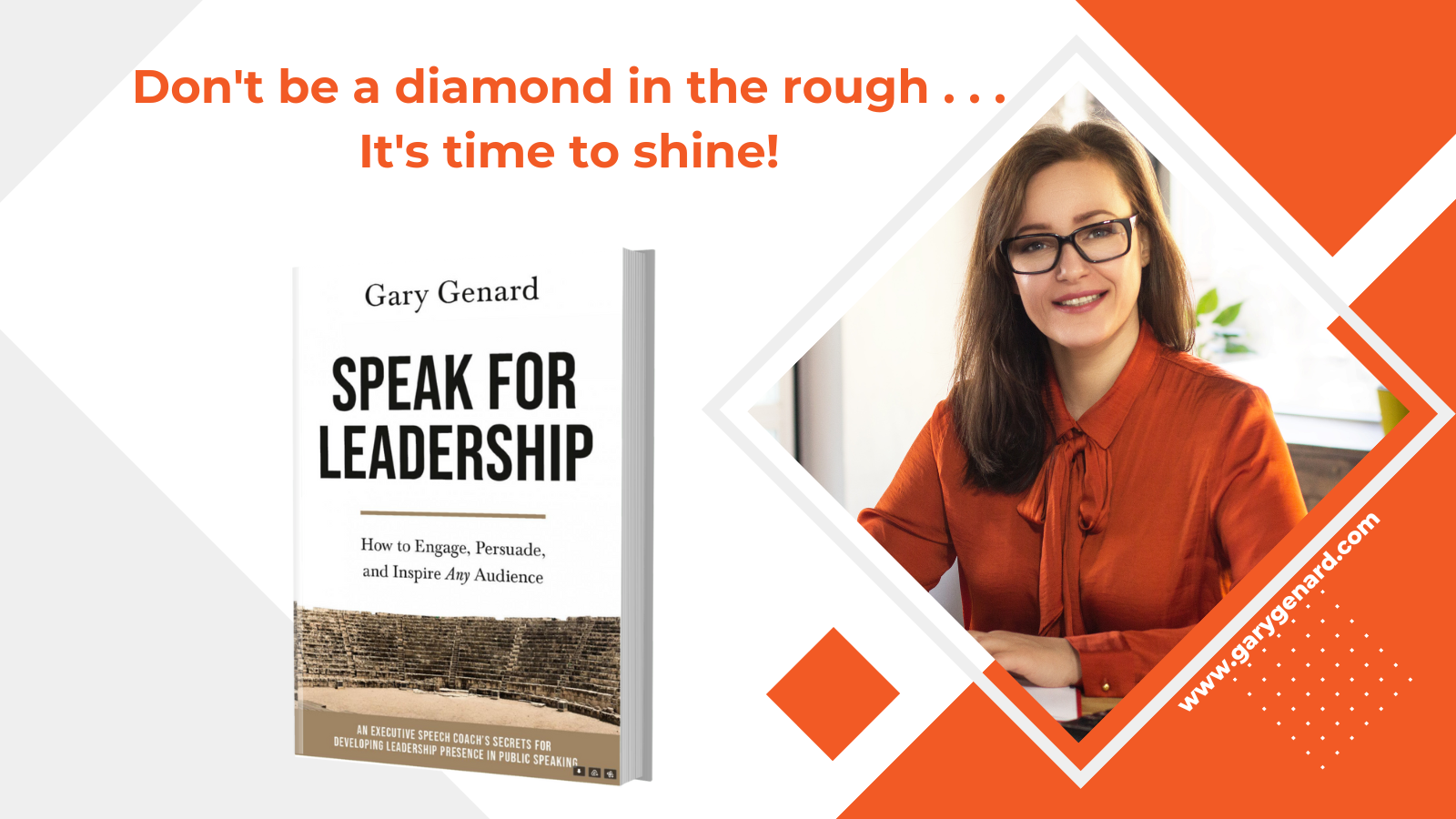
Speak more dynamically with my book, Speak for Leadership. You'll also find it here on Amazon. Discover a speech coach's secrets for developing leadership presence!
You can start by adopting the mindset that great speakers have: that your job is to influence audiences powerfully in terms of your topic. Notice that operative word: "influence," not "inform." You may in fact inform people in your presentation. But that aspect of your talk—and every other one as well—gains in stature and purpose when you can change people's thinking and actions concerning the topic you share an interest in.
So assuming you have something important to say and you're talking to an audience that needs to hear it, here are five performance-based techniques to speak with charisma and impact.
Unlock your natural talents as a communicator. Download my Free ebook, 12 Easy Ways to Achieve Presence and Charisma. The career you boost just may be your own!
Five Ways to Be a More Memorable Speaker
1. Make strong eye contact. Simply put, no behavior is as fundamental to persuasion as looking at the person you're talking to. When was the last time you trusted someone who wouldn't look you in the eye?
So actively look at and relate to your audience when you speak. When I say "actively," I mean let your gaze linger for a half-second to a second, rather than "flicking" your eyes at listeners. They'll like you more, they'll decide that you're honest; and most important, they'll be more willing to be influenced by you. And ignore the silly advice about looking at individuals for specific amounts of time, or making eye contact with one person per sentence, etc.
Avoid people's gaze, on the other hand, just because you're nervous—or weakest of excuses, you're busy reading your notes—and you'll basically have no chance of changing their thinking or behavior. An additional consideration these days is why you need great eye contact in your virtual meetings and presentations.
2. Smile. As public speakers, we just don't smile enough. Smiling is a prerequisite to establishing trust with audiences, only slightly less important than eye contact. At the very least, it's evidence of the enjoyment I mentioned above. And of course, smiling brings considerable health benefits for the smiler!
In speaking situations where you feel a smile is inappropriate, "open" your countenance by assuming a more pleasant expression, which raises your cheekbones. As an illustration of what I mean by this, look at the famous painting American Gothic—that's the one of the sour-looking farmer with the pitchfork standing next to his sister. Now compare it with the Mona Lisa. There's a lady who knew how to raise her cheekbones, and look at how successful she's been!
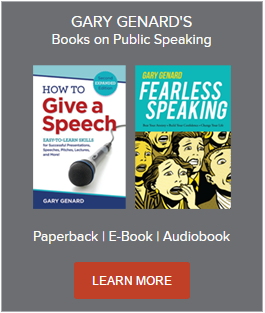
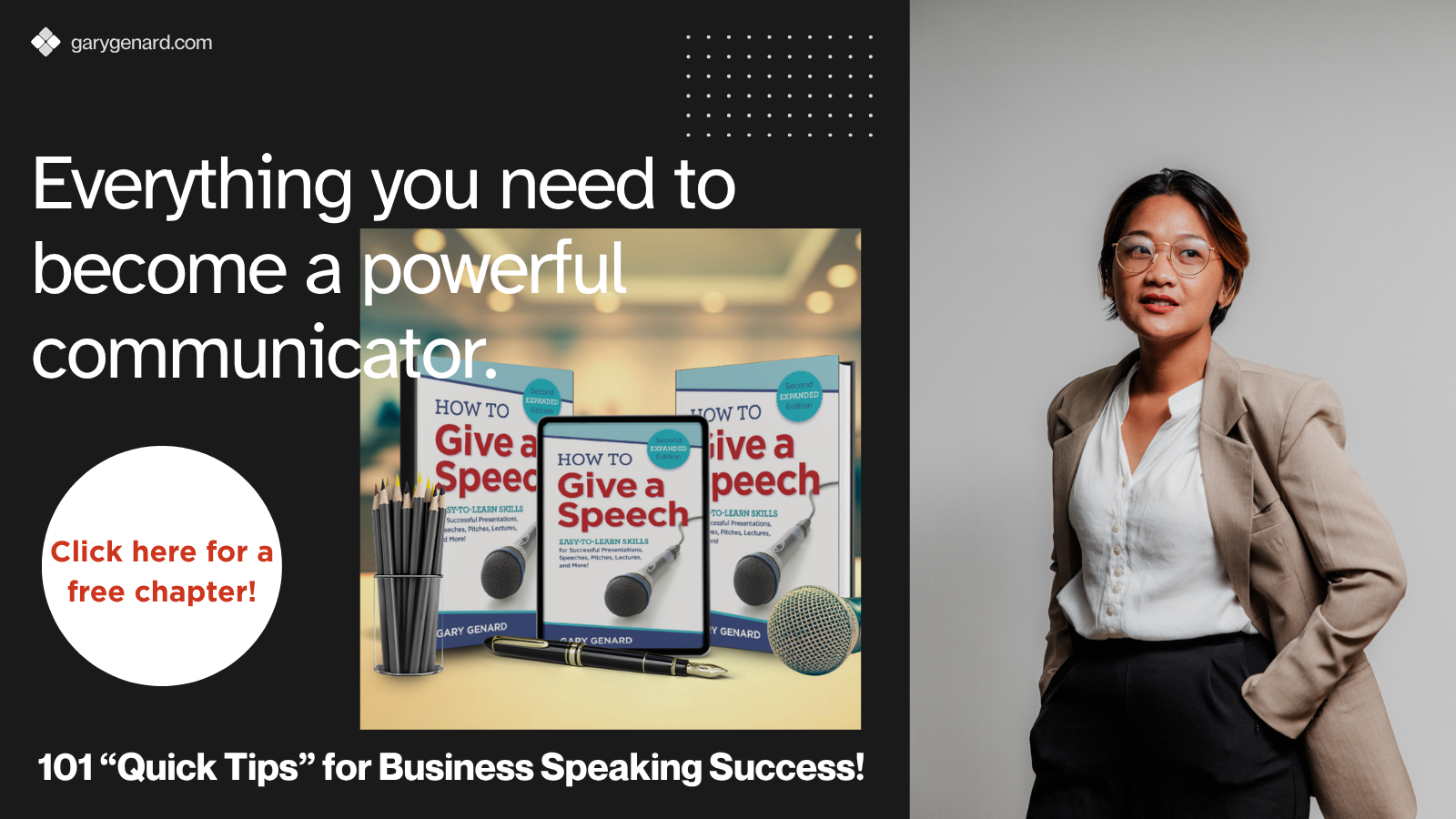
We all speak in different settings and situations. Get my public speaking handbook, How To Give A Speech, to learn how to speak at your best every time. It's also here on Amazon.
3. Energize your voice. Have you ever had to strain to hear a speaker? Soft-talkers and under-energized presenters make us do too much work. Worse, a speaker like that seems distant, and we feel somehow that we've been left out of the loop.
You need always to generate enough vocal power and energy to reach every listener in the room, including the people in the back and those that are hard of hearing. Remember also that your vocal energy must change in different spaces: the larger the speaking venue, the more you must project your voice. (Obviously, don't increase your volume if you're being miked.) In spaces that echo, you'll have to speak more slowly so you don't override your own speech. Here are five ways you can improve your vocal skills for business.
When your voice is energized and well projected, you make everything easier for your listeners. They can relax instead of working overtime to hear and understand what you're saying. After all, connecting with audiences (vocally and otherwise) is one of the keys to presentation success.
4. Be aware of your nonverbal messages. Visuals have tremendous power in public speaking—and the most important visual is you. What your body tells the audience is no less critical to your success than what your voice and the words are saying.
Keep two factors in mind concerning nonverbals: (1) consider how you can give physical expression to what you're saying. And (2) make your words and gestures congruent, i.e., use body language that matches what you're saying. (An example of a noncongruent message: Shaking your head back and forth as you're saying "Yes.")
So, learn the key body language techniques for public speaking! (And download my Free White Paper, The Body Language Rules: 12 Ways To Be A More Powerful Speaker.) Practice them using a mirror or video camera. Then forget about them when you speak. Your focus and all your attention should be on your message and getting it across to your listeners. If you've internalized the skills of body language, they'll be there for you without any calculated thought.
5. Have fun. Now there's a novel concept in public speaking! Somehow, we've imbued speaking in public with an aura of inconvenience, horror, and even torture. But think about your own experiences as an audience member. Are you more comfortable listening to a speaker who's grimly carrying on, or one who seems to be enjoying himself or herself?
When you speak with verve, you broadcast a completely different message than "I'm doing hard work here." Instead, your audience sees a person who not only has something valuable to say, but appreciates the opportunity to say it. It must be good stuff—look at how much he or she likes talking about it! Pretty soon, they're enjoying themselves as well.
You should follow me on Twitter here.

Gary Genard is an actor, author, and expert in public speaking and overcoming speaking fear. His company, The Genard Method offers live 1:1 Zoom executive coaching and corporate group training worldwide. He is the author of the Amazon Best-Seller How to Give a Speech. His second book, Fearless Speaking, was named in 2019 as “One of the 100 Best Confidence Books of All Time.” For nine consecutive years, he was ranked by Global Gurus as one of The World’s Top 30 Communication Professionals, and he has been named as one of America's Top 5 Speech Coaches. His handbook for presenting in videoconferences, Speaking Virtually offers techniques for developing virtual presence. He is also the author of Speak for Leadership: An Executive Speech Coach's Secrets for Developing Leadership Presence. His latest book is The Confidence Book: 75 Ways to Reduce Your Anxiety, Let Go of Your Fears, Change Your Negative Thinking, and Perform At Your Professional Best. He is also the creator of The Dr. William Scarlet supernatural thrillers. Contact Gary here.
Photo credit: iggii on unsplash.com