
Learn how an actor's techniques can show you how to speak with style! Master the art of performance for public speaking.
What is stage presence?
Google defines it as “The ability to command the attention of a theater audience by the impressiveness of one's manner or appearance.” I think that's as good a definition as any.
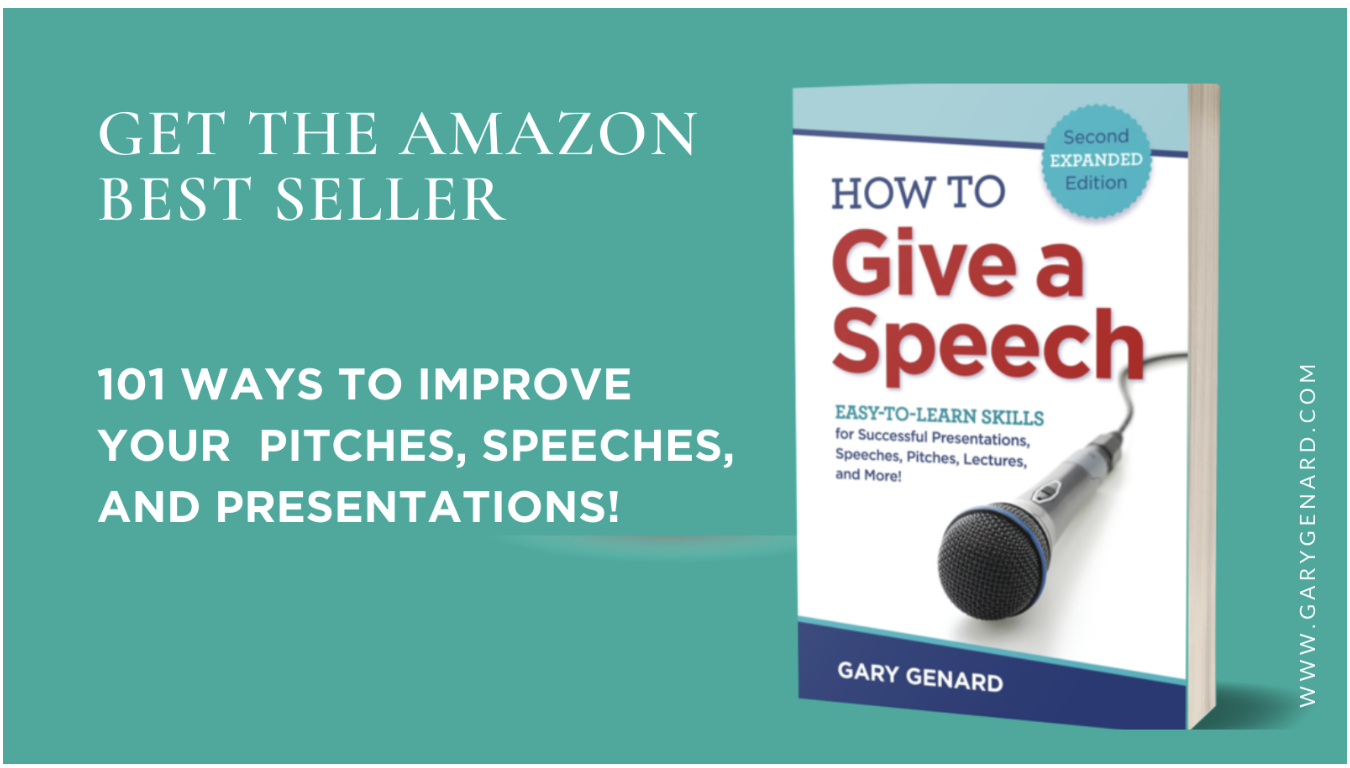
Get the essential guide to great speaking: How To Give a Speech. Discover 101 easy-to-learn-skills for speeches, pitches, presentations, and more! Also available on Amazon.
The reason we may struggle at times to understand the term, is that stage presence exists in the mind of the audience. That means that as speakers, we can’t grab a handful to make sure we have an adequate supply before we step on stage.
I do like two parts of the Google definition, however: “command the attention of an audience”; and that word “impressiveness.” For when it comes to speaking, as with all applications of stage presence, you must achieve both of those ends to take your performance beyond the ordinary.
Go from boring to brilliant! Download my Free eguide, Four Ingredients of Extraordinary Presentations. Learn my secrets for great speeches and presentations.
The Problem with Public Speaking in America
Before discussing the specifics of stage presence for speaking, we need to understand that America has a monkey on its back: a problem we collectively need to do something about. It has to do with how we’re taught—or not taught—public speaking.
The unfortunate fact is, we don't teach our children how to communicate effectively in terms of being confident, comfortable, and charismatic speakers. And of course, those children become all of us.
Our schools continue to teach reading and writing—many thousands of hours of it through our years of grade school, high school, college and professional programs. But little or no time is spent on oral communication skills, listening skills, negotiating skills, and even how to handle ourselves in front of an audience. So when we enter the world of business and the professions, we're at a loss as to how to practice our most prevalent activity: speaking.
Aim for maximum presence and influence every time you speak! Download my essential cheat sheet, "10 Ways to Stay Fully Focused when Speaking."
Where then do we find the skills to quickly and effectively overcome this deficit? We uncover them in what's really the most logical place in the world: the theater.
So here’s a modest proposal with a theater-based approach for grasping the golden ring of stage presence when you speak in public. My remarks here aren’t meant to be prescriptive—they’re intended simply to open the discussion. In subsequent blogs, I’ll explore each of the five points below in more detail. And each time, I’ll be speaking from the viewpoint of an actor who now trains people in public speaking and effective oral communication.
Public Speaking Is a Reflection of Who You Are
What often gets us into trouble where public speaking is concerned is the idea that it’s something special—an out-of-the-ordinary event, in which we need to rise above our ordinary competencies. But we're continually performing, adjusting our demeanor throughout each day based on the needs of the people we’re with and the situation we're facing.
Just as important is the realization that you can’t hide when you speak in public. Audiences will always understand who you are—unless you spend all your energy hiding your true nature, and what kind of presentation is that? Don’t forget: audiences truly want to know you and to connect with you. So make that your be-all and end-all, rather than trying to be excellent.
Acting Techniques: Intention and Beats
When an actor plays a role, he or she is strongly focused on the intentions of the character. The stronger the force compelling that character forward, the more raw material the actor has to work with. And in any worthwhile drama, conflicts occur that result in new intentions, scene by scene. When the character’s intention changes to meet those new conditions, that’s a new beat.
In my coaching and training, I equate an actor’s beats with your main points as a speaker. As you move through your speech, each new main point you raise creates a moment of renewed interest for your audience. You should therefore become aware of how your talk unfolds in these terms, making each new main point look and sound different for listeners.
Acting Techniques: Physical Expressiveness
As speakers, we constantly run the risk of becoming talking heads. But your body is an essential tool of oral communication: from gestures to facial expressions to your proximity to your audience. So if you want to speak with presence, you’d better get your body into the act.
Learn the skills of physical expression for dynamic presentations. Download my Free White Paper, The Body Language Rules: 12 Ways To Be a More Powerful Speaker.
In other words, to be the kind of speaker who commands attention and is impressive to watch, your speaking persona needs a physical dimension. So if you’ve never considered physical expressiveness as an element of your presentations, do so now. Watch TED talks to get an idea of how some speakers enliven their speeches in this way while others remain static and uninteresting to observe. Visuals are seductive as hell, including the visual that is you.
Vocal Dynamics for Public Speaking
Just as words have no physical dimension without your help, your beautiful language won’t sing unless you give it voice. As a speaker, you need a fully expressive vocal instrument, as it’s one of the skills that ushers presence on stage or leaves it in the wings.
Keep this critical point in mind: Your voice is your most powerful instrument for creating in listeners the emotions you're feeling. If audiences didn’t need to hear the sound of truth or the power of an idea, why would you be speaking at all? Remember: verbal is not vocal. Your words are one thing; the way you say them is something entirely different. Think Dr. Martin Luther King, Jr.'s "I Have a Dream Speech" and you'll understand this immediately. (To speak with maximum clarity and credibility, download my free cheat sheet on the 5 Key Tools of Vocal Dynamics.)
Using Your Performance Space to Command a Stage
When you think about nonverbal communication and public speaking, do you consider only posture, stance, and hand gestures? If you do, you're ignoring your need to use space productively and to command the stage when you speak.
In a later blog, I'll explore how an actor’s techniques of stage directions and blocking are custom-made to lead audiences in public speaking. For now, I’ll suggest one simple idea: begin to think in terms of your performance space itself as an element of stage presence. Just as your venue (its shape, acoustics, degree of accessibility between speaker and audience, etc.) has a hand to play in your public speaking effectiveness, so too does the stage you’re standing on.
Actors speak of theatrical performance as being “on the boards,” as indeed it is. Use that space—the floor itself—as you move through your narrative, and to bring you closer to the audience for your important points. You may be amazed at how much more lively and watchable your presentation becomes. More important, your audience may be amazed as well.
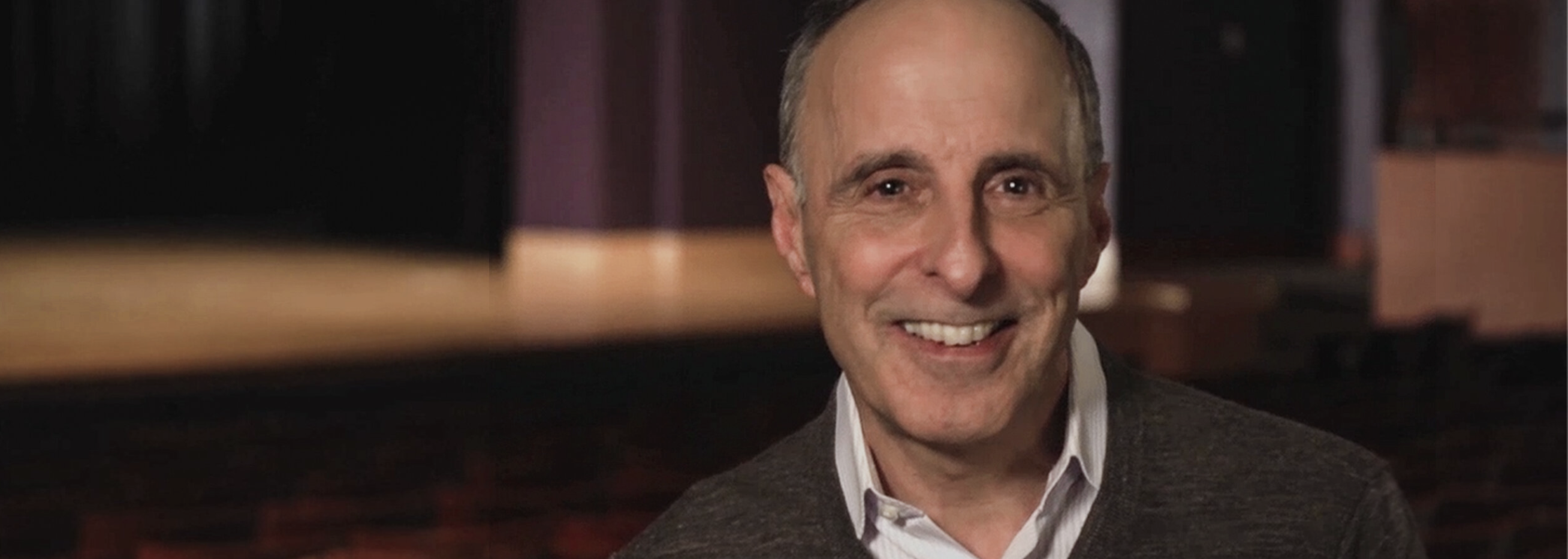
Gary Genard is an actor, author, and expert in public speaking and overcoming speaking fear. His company, The Genard Method offers live 1:1 Zoom executive coaching and corporate group training worldwide. He is the author of the Amazon Best-Seller How to Give a Speech. His second book, Fearless Speaking, was named in 2019 as “One of the 100 Best Confidence Books of All Time.” For nine consecutive years, he was ranked by Global Gurus as one of The World’s Top 30 Communication Professionals, and he has been named as one of America's Top 5 Speech Coaches. His handbook for presenting in videoconferences, Speaking Virtually offers techniques for developing virtual presence. He is also the author of Speak for Leadership: An Executive Speech Coach's Secrets for Developing Leadership Presence. His latest book is The Confidence Book: 75 Ways to Reduce Your Anxiety, Let Go of Your Fears, Change Your Negative Thinking, and Perform At Your Professional Best. He is also the creator of The Dr. William Scarlet supernatural thrillers. Contact Gary here.