Do you know how to hook an audience, then conclude powerfully every time? Here's how to conclude your speeches vividly and memorably.
Great public speakers know they have to begin and end their speeches strongly. That's because of two concepts concerned with an audience's engagement and attentiveness.
Primacy states that audiences will remember most vividly what they experience at the start of a talk. And recency says that they'll also remember what's said at the end. In terms of public speaking, that means knowing how to begin a presentation effectively, and how to conclude it. This article concerns the latter.
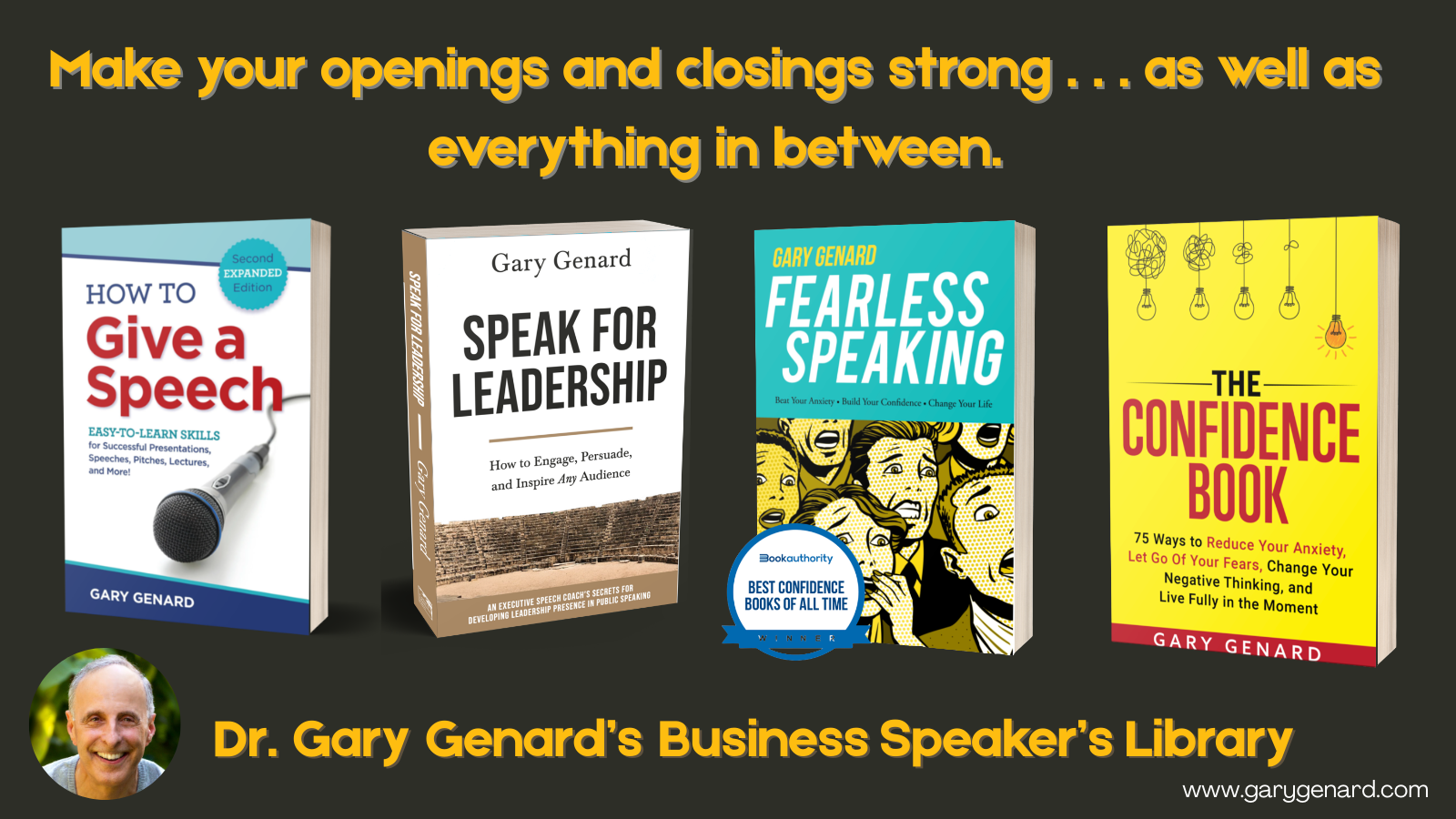
Start and end your presentations strongly with my books How to Give a Speech, Speak for Leadership, Fearless Speaking, and The Confidence Book. Also find them on Amazon.
Engaging Listeners in Your Opening and Closing
Speakers throughout history have understood the importance of a strong beginning and ending. Even today, the smart presenter spends the time and attention necessary to craft a "hook" or "grabber" that immediately and powerfully gets an audience onboard.
Want to command attention as a speaker? Learn how to stay in "The Zone" for maximum presence. Get my free cheat sheet, "10 Ways to Stay Fully Focused when Speaking."
Some types of openings are guaranteed to get an audience on your wavelength right away. I call them "grabbers." They are actually rhetorical devices designed for speeches, presentations, pitches, lectures, and all examples of public speaking. Here are a dozen of these effective opening gambits:
- Question
- Story
- Quotation
- Visual (including the rules for succeeding with PowerPoint)
- Statistic
- Startling statement
- Personal anecdote or experience
- Humor
- Expert opinion
- Model or demonstration
- Testimony or success story
- Today's headline or hot online topic
How to Create a Strong Conclusion to Your Speech
Let's say you've taken that advice in the paragraphs above, and you've launched your speech powerfully using one of these approaches. You've also managed to keep everyone's attention as you developed your message. Now you're ready for the other critically important segment of your presentation: your conclusion.
Remember, recency states that listeners will likely retain the last thing you say. So you don't want to end weakly, with a presentation that falls to earth like a leaking balloon. "Quit while you're ahead," and "Always leave 'em laughing," are two well-known sayings that embody the principle that a speech should end as strongly as it begins.
Now, think about the conclusions to all the speeches and presentations you've listened to over the past year. How many of them were memorable? How many of them even had a conclusion?
No matter how great your material, your speaking style is crucial to your success! Download my Free resource, "Great Speaking? It's About Performance Over Content."
One of the most common public speaking shortcomings, in fact, is the lack of a memorable closing that drives home your message. For audience members, this can feel like being on the receiving end of a shaggy dog story. Or to put it another way: a speech without a conclusion leaves listeners hungry for a last satisfying mouthful.
Why would you want to leave your audience without dessert?
Just as you grabbed listeners' attention at the start of your speech, you must ensure that your conclusion is memorable. It should also vividly re-focus listeners on your core message.
Want to raise the bar on your next talk? Get the 2nd expanded edition of the Public Speaking Handbook, How to Give a Speech. Discover 101 tips to speak with charisma!
As with your introduction, a solid conclusion takes thought, and sometimes a dash of creativity. But here's some good news: The same list of a dozen springboard devices I mentioned above as openers, can be used to conclude your speech. After all, the goal is the same: to be dramatic, provocative, or engaging enough so your message is "sticky."
And along with those devices, here is a "Triple-T" of powerful clinchers that can help seal the deal with audiences:
- Thesis-Antithesis
- Triad (any list of three)
- Tribute
Use Expert Opinion as a Public Speaking Tool
A witticism from Oscar Wilde or Mark Twain, or a quotation from Simon Sinek or Brené Brown, can do wonders to conclude your talk. I also suggest looking outside your narrow field of expertise to find a connection that's unexpected and therefore invigorating.
As Yogi Berra said: 'It ain't over till it's over," so why not use your last opportunity to bring your message home?
Here are examples of outstanding conclusions that use my "Triple-T" of powerful clinchers:
- John F. Kennedy, Inaugural Address: "And so, my fellow Americans: ask not what your country can do for you, ask what you can do for your country. My fellow citizens of the world: ask not what America will do for you, but what together we can do for the freedom of man." (Thesis-Antithesis)
- 1999 Nobel Prize Acceptance Speech of Dr James Orbinski, President of the Médecins Sans Frontières (Doctors Without Borders) International Council: "Humanitarian action exists only to preserve life, not to eliminate it. Our weapons are our transparency, the clarity of our intentions, as much as our medicines and our surgical instruments. Our weapons cannot be fighter jets and tanks, even if sometimes we think that their use may respond to a necessity. The humanitarian is not the military, and the military is not the humanitarian. We are not the same, we cannot be seen to be the same, and we cannot be made to be the same." (Triad) (The previous sentence is another example of thesis-antithesis.)
- Ladybird Johnson's 1964 speech on Eleanor Roosevelt: "Let us today earnestly resolve to build the true foundation for Eleanor Roosevelt's memory—to pluck out prejudice from our lives, to remove fear and hate where it exists, and to create a world unafraid to work out its destiny in peace. Eleanor Roosevelt has already made her own splendid and incomparable contribution to that foundation. Let us go and do likewise, within the measure of our faith and the limits of our ability. Let Eleanor Roosevelt teach us all how to turn the arts of compassion into the victories of democracy. (Tribute)
And you noticed as well the triad in that last example, didn't you?
Some more of my blogs on this topic:
- How to Start a Speech -- 12 Foolproof Ways to Grab Your Audience
- Start Strong! -- Give Your Audience a Greeting They'll Remember
- Curtain Up! -- Adding Drama to Your Speeches and Presentations.
You should follow me on Twitter here.
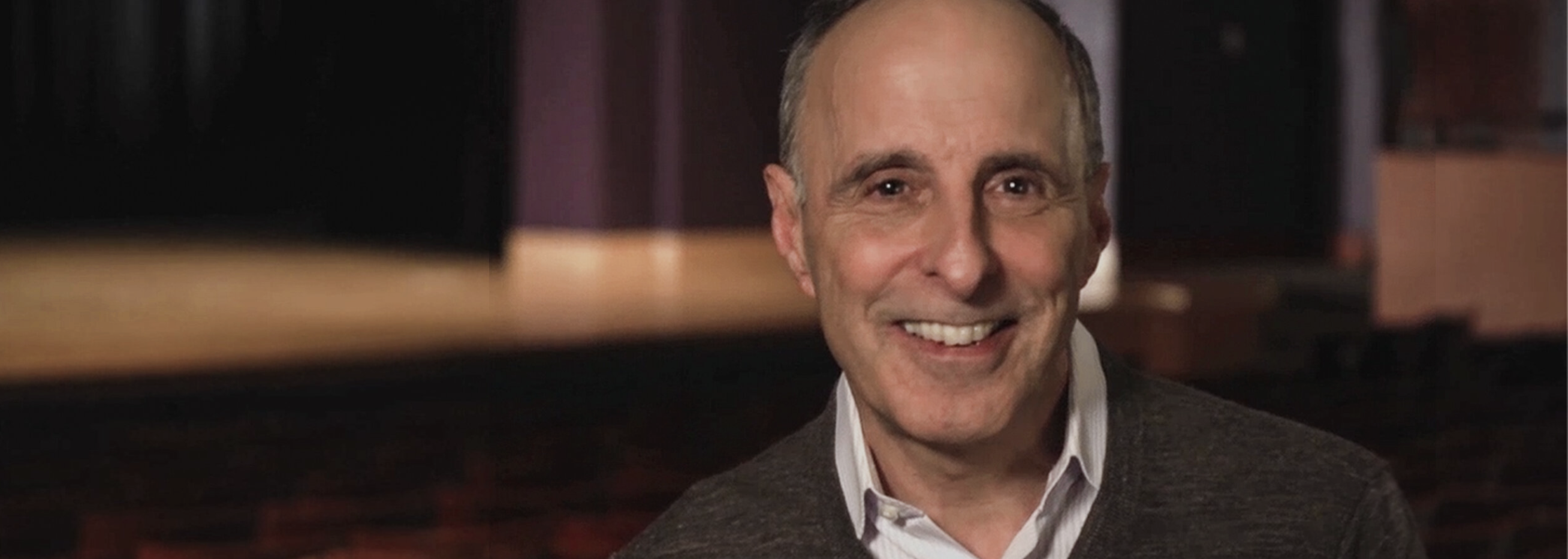
Gary Genard is an actor, author, and expert in public speaking and overcoming speaking fear. His company, The Genard Method offers live 1:1 Zoom executive coaching and corporate group training worldwide. For nine consecutive years, he was ranked by Global Gurus as one of The World’s Top 30 Communication Professionals. He is the author of the Amazon Best-Seller How to Give a Speech. His second book, Fearless Speaking, was named in 2019 as "One of the 100 Best Confidence Books of All Time," and he has been named as one of America's Top 5 Speech Coaches. His handbook for presenting in videoconferences, Speaking Virtually offers techniques for developing virtual presence. He is also the author of Speak for Leadership: An Executive Speech Coach's Secrets for Developing Leadership Presence. His latest book is The Confidence Book: 75 Ways to Reduce Your Anxiety, Let Go of Your Fears, Change Your Negative Thinking, and Live Fully in the Moment. He is also the creator of The Dr. William Scarlet psychic mysteries. Contact Gary here.