
Your voice is a key business tool for influencing stakeholders. Here's how to develop a voice that's healthy, friendly, energetic, and authoritative.
Your voice. You've heard about "finding your voice," and "speaking in your true voice." That's figurative language reminding us that our voices are at the core of who we are and how we present ourselves to the world.
Then there's your physical voice. It's easy to forget that the voice is produced through muscular and mechanical forces, and that effective vocal skills depend upon good breathing and use of the muscles in the larynx. Efficient use of that system of breathing and muscular action that produce the voice is as important as it is for, say, training for and running a marathon.
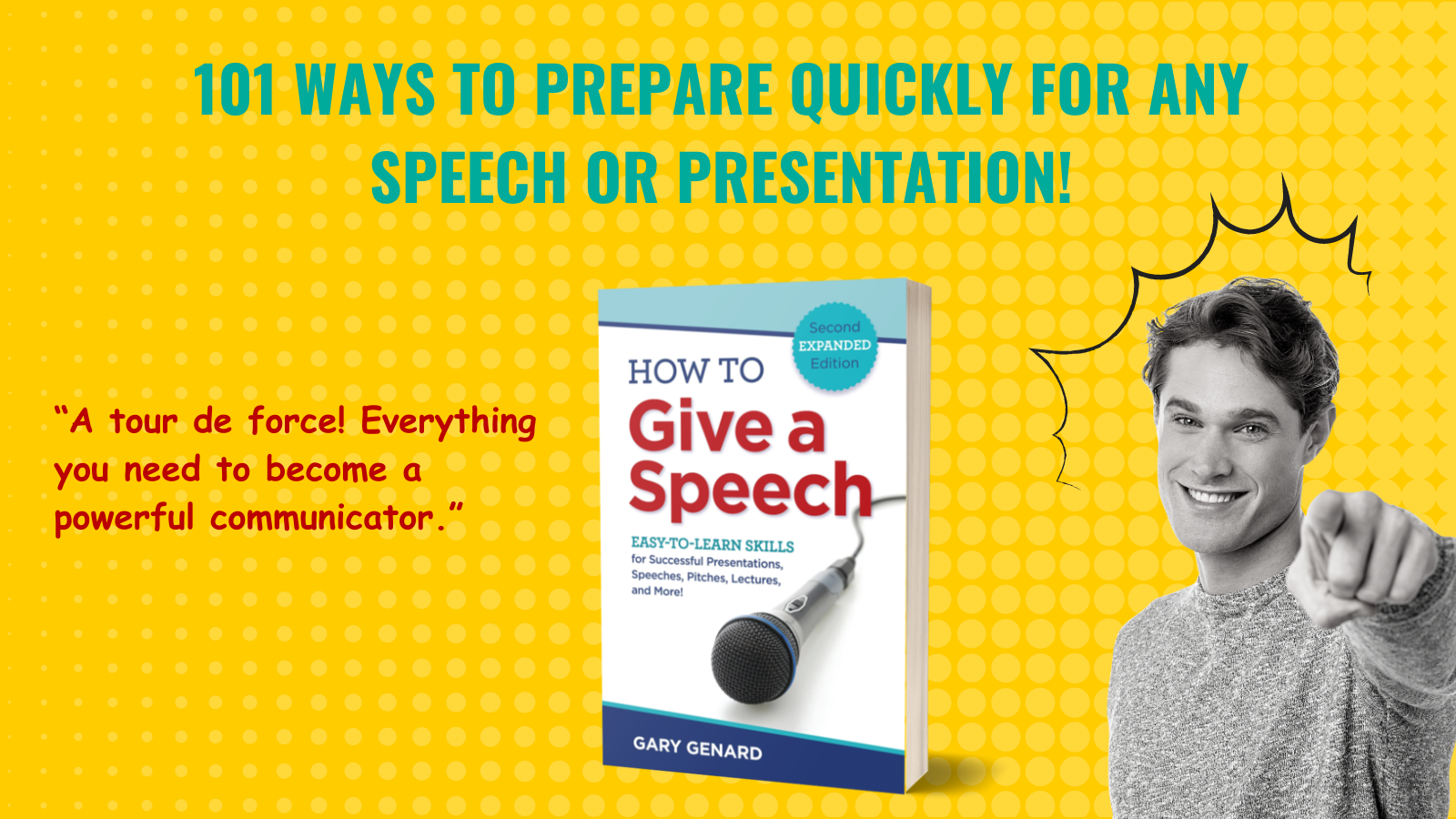
Read Chapter 8, "The Power of Your Voice," in my book, How to Give a Speech. You'll also find it here on Amazon. Learn 101 ways to improve your speeches and presentations!
The Importance of Your Voice in Business
Does all of this have anything to do with how you use your voice professionally? You can get a sense of that by trying the following exercise:
Listen to your voice the next time you're trying to convince someone about something that matters deeply to you. You'll understand how much of your ability to share the things you're passionate about, to speak from the heart and to influence others depends upon your voice. Of course, that goes for your career as well as your personal life.
Your voice is essential for your ability to speak clearly, convincingly, and with credibility. Boost your effectiveness with my free sheet cheat, "5 Key Tools of Vocal Dynamics."
A 2016 Wall Street Journal article reflected the connection between personal voice and professional success. The story, "Your Voice, Only Younger," discusses ways that physicians and researchers are finding ways to help people keep their voices healthy.[1]
So here’s my own take on three ways you can keep your voice young, energetic and friendly without losing power and authority. Call it an actor and speech coach’s riff on the ongoing need to use your full vocal toolbox to create positive responses in your audiences.
Hey how about those important phone calls and conference calls? Find out more in my Free eGuide, How To Improve Your Vocal Presence on the Phone. Download it now!
How to Increase Vocal Power for Public Speaking
Let's start with vocal power. You don't have to be suffering from the loss of muscle mass in the vocal folds that comes with age (highlighted in that Wall Street Journal article) to benefit from developing a strong speaking voice. In fact, when it comes to gaining authority and credibility with audiences, you need to enlist your voice in the effort whatever your age.
It all begins with breathing. If you don't already know how to breathe diaphragmatically for more vocal power, you need to learn. Remember these two things to generate a more powerful voice without strain: (1) vocal power starts in the belly area not the throat, and (2) if you want to fill a room with the power of your voice, think in terms of energy rather than loudness.
And what about online meetings and videoconferences. Speak at your best! Download my Free eGuide, Essential Speaking Tips for Videoconferences. Boost the 'virtual you'!
Your vocal cords (they're actually folds of muscle) are activated by exhaled air; and the stronger the energy applied to those muscles, the more powerful the sound created will be. So get your diaphragm into the act, for that creates enough space for your lungs to expand fully. The full reservoir of air will create sufficient energy for strongly activated vocal folds, i.e., a more powerful sound. If you try instead to increase power and loudness in your throat, you'll put too much strain on the muscles in the larynx, and your voice will sound hard and unpleasant. How can you harness that increased breath capacity for vocal success? Keep reading!
Sustaining the Sound to Fully Express Your Ideas
What you want to do now is sustain the sound you're creating through all that good breathing to power the voice. That way, your voice will not only have excellent resonance, but you'll be able to easily project it throughout the space you're speaking in. (Again, it's a question of energy, not trying to produce greater volume.)
There's another important consideration: in English, the most important word or phrase usually comes at the end of a vocalized idea, not at the beginning or in the middle: "We're not only going to succeed with his product—this is going to make us the leaders in this industry!" You can clearly hear how the, er, business end of this spoken idea comes at the end!
How to support your vocal sound: Start with a deep breath (your belly should move outward to reflect the diaphragm's action), then vocalize a fairly loud hum: "Mmmmm." Now, keeping the sound going, open your mouth wide, so it sounds like "Maaaaa." Keep the sound strong and steady, i.e., don't let it trail away. When you start running out of air, stop. You're now producing well supported sound. Take it a step further by actually speaking, maintaining a strong voice to the end of the idea you're expressing. Record yourself; if you find that you trail off at the end of an idea, make this exercise in sustaining your sound part of your vocal warm-up.
Here's a way to make your voice more relaxed, calm, and enjoyable to listen to: my Free cheat sheet, "How To Calm Your Nerves Before Speaking." Be dynamic and in control!
Make Your Voice Sound Younger and More Energetic
Now here's a simple exercise that can help your voice sound younger, brighter, and livelier. It involves using what I call the "upper regions" of your pitch.
"Pitch" in vocal terms simply means the highness or lowness of your voice on the musical scale. Some of us have naturally lower or higher pitches than others. What matters is that you include variety by inflecting your pitch—hence the term "pitch inflection." We all know that an uninflected pitch means speaking in one tone, or a "monotone". And from that comes "monotonous."
Some speakers adopt a fairly low pitch and refuse to budge from that starting place. But it's important to use the higher regions of your pitch not only to keep people from falling asleep. It also gives your voice a lighter quality which is often perceived as younger, more energized, and more intelligent. That's not a bad exchange: trading a rusty vocal habit for one that may add to your ability to be a livelier presence for audiences.
Power, vitality, energy, and variety. Work on these aspects of your sound. Your voice and your "voice" will both benefit.
[1] Andrea Petersen, “Your Voice, Only Younger,” The Wall Street Journal, October 25, 2016, D1-D2.
You should follow me on Twitter here.

Gary Genard is an actor, author, and expert in public speaking and overcoming speaking fear. His company, The Genard Method offers live 1:1 Zoom executive coaching and corporate group training worldwide. He is the author of the Amazon Best-Seller How to Give a Speech. His second book, Fearless Speaking, was named in 2019 as “One of the 100 Best Confidence Books of All Time.” For nine consecutive years, he was ranked by Global Gurus as one of The World’s Top 30 Communication Professionals, and he has been named as one of America's Top 5 Speech Coaches. His handbook for presenting in videoconferences, Speaking Virtually offers techniques for developing virtual presence. He is also the author of Speak for Leadership: An Executive Speech Coach's Secrets for Developing Leadership Presence. His latest book is The Confidence Book: 75 Ways to Reduce Your Anxiety, Let Go of Your Fears, Change Your Negative Thinking, and Perform At Your Professional Best. He is also the creator of The Dr. William Scarlet supernatural thrillers. Contact Gary here.
Photo credit: Artur Voznenko on unsplash.com